Table of Contents
Cyprus has been making wine for over 5,500 years, and at the heart of this ancient tradition lie the island’s native grapes. While international varieties like Cabernet Sauvignon and Chardonnay have dominated global wine markets, Cyprus is experiencing a renaissance. Winemakers are rediscovering and championing the indigenous grape varieties of Cyprus that survived millennia of changing rulers, climates, and tastes.
This guide will walk you through everything you need to know about these remarkable grapes, from their history and characteristics to where you can taste them today.
Why Cyprus’s Native Grapes Matter More Than Ever
The Mediterranean island of Cyprus sits at the crossroads of Europe, Asia, and Africa. This unique position has shaped not just its history, but also its viticulture. The indigenous grape varieties of Cyprus evolved over thousands of years to thrive in the island’s hot, dry conditions with minimal water and inputs.
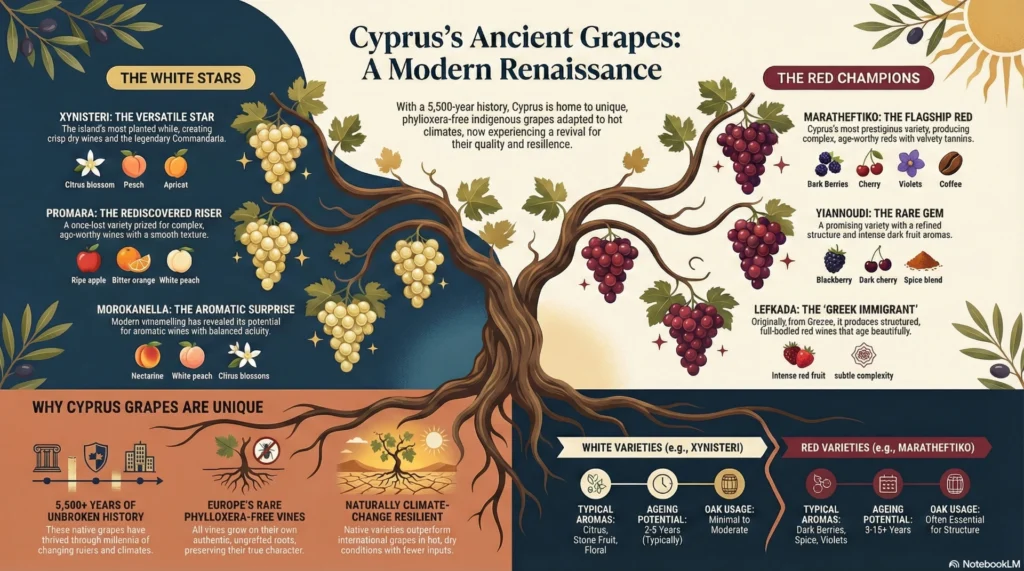
Today, as climate change puts pressure on traditional wine regions worldwide, these native varieties are attracting serious attention. Research has shown that Xynisteri and Maratheftiko perform better in hot, dry conditions than international varieties like Shiraz and Sauvignon Blanc when grown in the same environment.
Cyprus also enjoys a unique advantage: it remains one of the few phylloxera-free zones in Europe. This means all vines grow on their own roots, ungrafted, preserving their authentic character.
The Heroic Rediscovery of Lost Varieties
For centuries, Cyprus’s indigenous grapes nearly vanished. During the 300-year Ottoman occupation, commercial wine production was prohibited, and heavy taxation caused many varieties to decline. Only small plantings scattered in family vineyards kept them alive.
In the late 20th century, oenologist Akis Zambartas embarked on a groundbreaking research project that would change Cypriot wine forever. Working with KEO winery, Zambartas spent three years scouring the island’s vineyards, searching for rare vines that old growers remembered from their grandfathers’ time.
The effort was remarkable. Zambartas and his team discovered 12 native varieties, many barely surviving in the corners of Mavro and Xynisteri vineyards. Some had names; others didn’t. Zambartas named several varieties himself, including Michalias (after the vineyard owner in Panayia), Omoio (because it looked like Maratheftiko), and Maroucho (after the vineyard where it was found).
French ampelographer Pierre Galet later validated these discoveries, confirming their indigenous status and recording them for posterity. This work earned Akis Zambartas membership in the prestigious International Academy of Wine (AIV).
Today, his son Marcos Zambartas continues this mission at Zambartas Wineries, recently purchasing a vineyard planted in 1921 that may contain even more undiscovered varieties.
The Major White Varieties
Xynisteri: Cyprus’s Versatile White
Xynisteri is the most widely planted white grape on the island, and its name translates to “low in acidity.” Don’t let that fool you though. When grown at higher altitudes in Cyprus’s mountainous regions, Xynisteri produces crisp, refreshing wines with excellent acidity.
Characteristics
- Light golden-yellow color
- Aromas of citrus blossoms, chamomile, and mirabelle plums
- At higher altitudes: Riesling-like petrol notes develop
- Medium body with mineral undertones
- Stone fruit flavors (peach, apricot) that develop into honey with age
Research shows Xynisteri has the highest stomatal density among Cypriot varieties, allowing it to better regulate water loss and tolerate drought conditions. The variety also demonstrates remarkable versatility, used for everything from crisp dry whites to the legendary sweet wine Commandaria.
Where to experience it: Try exceptional examples at Vlassides Winery, Tsiakkas Winery, and Kyperounda Winery.
Promara: The Early Riser
Promara gets its name from its early ripening nature. This white variety was once widespread but nearly disappeared until its rediscovery.
Characteristics
- Pale golden-green berries
- Thick skin provides natural disease resistance
- Complex nose of ripe apples, bitter orange, and green beans
- Smooth texture with balanced acidity
- Flavors of water-melon and white peach
- Oak aging adds smoky, brandy-like complexity
Promara wines from 2014-2016 vintages have shown excellent aging potential, developing more complexity while maintaining freshness. The variety produces wines with good body and a pleasant, slightly heavy finish that benefits from aging.
Where to experience it: Vouni Panayia Winery, Ktima Gerolemo amongst others produces outstanding single-varietal Promara wines.
Morokanella: The Cinnamon Grape
Morokanella means “little cinnamon,” though the reason for this name remains a mystery. This white variety was widely spread during the early Ottoman occupation but fell into severe decline due to heavy taxation.
Characteristics
- Pale, almost near-white grapes
- Aromatic and rich wine profile
- Complex flavors with balanced acidity
- Notes of nectarine, white peach, and citrus blossoms
- Herbal undertones
- Pleasant, lingering aftertaste
For years, Morokanella was dismissed as producing flabby, neutral wines. However, modern winemaking techniques and careful site selection at controlled altitudes have revealed the variety’s true potential. Zambartas selected Morokanella as one of only five rediscovered varieties with real potential for quality winemaking.
Where to experience it: Look for bottles from Aes Ambelis, Gerolemo, and Vasilikon wineries.
Spourtiko: The Pollinator
Spourtiko takes its name from the Greek word for “bursting,” as its thin-skinned berries tend to split easily. This white variety plays a crucial role beyond its own wines: it’s the key to Maratheftiko production.
Characteristics
- White berries with thin, delicate skins
- Yeasty, grapey aromas
- Peach flower notes
- Nice texture with good body
- Balanced acidity
- Water-melon flavors with bitter orange finish
Spourtiko flowers at the same time as Maratheftiko and provides the pollen needed for the latter’s female flowers. After extensive experimentation, Zambartas identified Spourtiko as the ideal pollination partner for Maratheftiko vineyards.
Where to experience it: Makarounas and Fikardos Winery produce single-varietal Spourtiko wines.
Kanella: The Other Cinnamon
Kanella means “cinnamon” and is possibly related to Morokanella, though the exact relationship remains unclear.
Characteristics
- White grape variety
- Aromatic precursors in the skins
- Pretty yellow color
- Rare, typically used in blends
Very little information is available about single-varietal Kanella wines, as it remains primarily a blending grape. More research is needed to fully understand its potential.
The Major Red Varieties
Maratheftiko: The Flagship Red
Maratheftiko (also called Vamvakada or Pampakina) stands as Cyprus’s most prestigious red variety. Jancis Robinson compared it to Cabernet Sauvignon for structure, though many winemakers now believe it’s closer to Pinot Noir in character.
Characteristics
- Deep ruby to garnet color
- Female flowers requiring co-planting for pollination
- Low yielding due to pollination difficulties (millerandage)
- Deeply colored, complex wines
- Aromas: dark berries, cherry, violets, coffee, cacao
- Herbal notes and sweet spice from oak aging
- High tannins and acidity
- Soft, velvety texture when properly vinified
- Excellent aging potential
The variety has a unique characteristic: fluffy white down on the back of its leaves to reduce evaporation in hot conditions. This trait led to its nickname “Pampakina” in the Pitisilia region (from the Cypriot word “παμπακι” meaning fluffy layer).
Zambartas describes Maratheftiko as “without doubt, the best variety of Cyprus.” When harvested and vinified correctly, it produces rich, intense red wines with characteristic aromas that blend harmoniously with vanilla notes from oak aging.
Where to experience it: Outstanding examples are produced at Zambartas Wineries, Ezousa Winery, Nicolaides winery, and Mallia Winery.
Yiannoudi: The Rare Gem
Yiannoudi was named after the garden where it was discovered (belonging to a man named Yiannis). This rare red variety shows tremendous promise but remains limited in production.
Characteristics
- Dark berries with thick skin
- Female flowers requiring co-planting (with Xynisteri, Mavro, or Syrah)
- Deep ruby color
- Aromas: blackberry, dark cherry, blueberry
- Spice notes (pepper, cinnamon)
- Refined structure with chalky tannins
- Lifted, persistent finish
- Excellent aging potential
Yiannoudi cuttings remain limited, and production is minimal. However, research and tastings have confirmed it produces interesting, high-quality wines. As plantings increase, Yiannoudi could become one of Cyprus’s signature reds.
Where to experience it: Marathasa Wine, Dafermou winery, and Mystes winery produce limited quantities.
Lefkada: The Greek Immigrant
Lefkada technically originated in Greece (from the island of Lefkada) but has been cultivated in Cyprus for so long that it’s considered part of the island’s heritage. DNA analysis confirms it’s identical to the Greek variety Vertzami.
Characteristics
- Deep red color
- Demanding during vinification
- Structured wines with body
- Subtle, complex flavors
- Intense red fruit aromas
- Benefits from malolactic fermentation
- Requires careful barrel maturation
- Develops harmonious equilibrium with age
Zambartas describes Lefkada as a “big” variety that produces rich wines, especially after proper oak aging. The variety presents challenges in both vineyard and winery but rewards patience with excellent results.
Where to experience it: Vasilikon winery has extensive experience with this variety, producing both single-varietal and blended wines.
Mavro: The Workhorse
Mavro simply means “black” in Greek, and this variety covers the largest area of any grape in Cyprus. It’s the foundation of Commandaria production and the most common red wine grape on the island.
Characteristics
- Dark berries
- High yielding
- Variable quality depending on vineyard practices
- Used for everything from bulk wine to Commandaria
- Better results from old vines and low yields
- Often blended with other varieties
While Mavro dominates Cypriot vineyards historically, quality-focused producers are reducing plantings in favor of more distinctive varieties like Maratheftiko and Yiannoudi.
Ofthalmo: The Disappointment
Ofthalmo means “bull’s eye,” named after the shape of its berries. Unfortunately, this light red variety has proven difficult to work with.
Characteristics
- Light red berries
- Usually planted at vineyard edges
- Produces light red and rosé wines
- Soft tannins
- Aromas of strawberry and raspberry when used in blends
- Weak wines with little interest as a single varietal
According to Zambartas’s research, plantings at Paphos yielded disappointing results, with wines lacking structure and character. More research is needed, particularly for white winemaking techniques, to determine if Ofthalmo has hidden potential.
Where to experience it: Nelion Winery
Additional Rare Varieties Under Research
Several other indigenous grape varieties of Cyprus exist in extremely limited quantities or only in experimental vineyards:
Flouriko (Vlouriko)
- Black grape variety
- Very rare
- Used primarily in blends
- Requires more research
Omoio
- Red grape variety
- Named “similar” because it resembles Maratheftiko
- Found in Panayia region
- No longer commercially cultivated
Michalias
- White grape variety
- Named after Michalis, the vineyard owner in Panayia
- No longer commercially cultivated
- May exist in old vineyards
Maroucho
- Red/black grape variety
- Named after Marouchos’s vineyard in Panayia
- No longer commercially cultivated
Other Historical Varieties
Additional varieties mentioned in historical records include Daktylidi, Hemoniatiko, Kliniotiko, Mardangura, Nezerkotiko, Tsakromoutiko, Skouro Mavro, Rodhino Rose, and Rozoudi Rose. Whether these still exist or are synonyms for known varieties remains unclear.
Comparing White vs. Red Indigenous Varieties
| Aspect | White Varieties | Red Varieties |
|---|---|---|
| Main Varieties | Xynisteri, Promara, Morokanella, Spourtiko, Kanella | Maratheftiko, Yiannoudi, Mavro, Lefkada, Ofthalmo |
| Climate Adaptation | Excellent drought tolerance, high stomatal density | Superior heat tolerance, adapted to minimal water |
| Typical Aromas | Citrus, stone fruit, flowers, herbs, minerals | Dark berries, spices, coffee, flowers, red fruit |
| Acidity | High to moderate, preserved at altitude | High, especially Maratheftiko |
| Tannins | N/A | Moderate to high, soft when properly managed |
| Oak Aging | Minimal to moderate | Essential for Maratheftiko, Lefkada, Yiannoudi |
| Aging Potential | 2-5 years for most, longer for premium Xynisteri | 5-15+ years for Maratheftiko, Yiannoudi, Lefkada |
| Production Challenges | Generally straightforward | Pollination issues for Maratheftiko, Yiannoudi |
| Best For | Food pairing, summer drinking, Commandaria base | Serious wine collectors, food pairing, aging |
The Timeline of Rediscovery
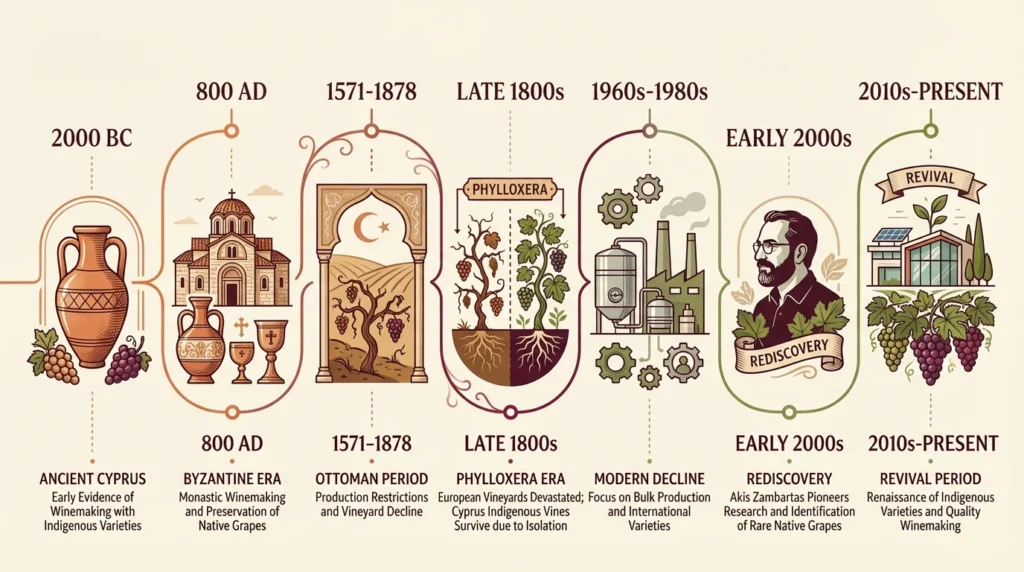
Understanding how the indigenous grape varieties of Cyprus came back from near extinction helps appreciate their significance:
Ancient Times to 1571: Cyprus wines legendary throughout Mediterranean; indigenous varieties thrive
1571-1878 (Ottoman Rule): Commercial winemaking prohibited; heavy taxation decimates Morokanella and other varieties; survival only in home vineyards
1878-1960 (British Rule): Winemaking tradition revived; fortification of Commandaria begins; focus mainly on Mavro and Xynisteri
1960s-1980s: Independent Cyprus focuses on bulk production; indigenous varieties other than Mavro and Xynisteri nearly lost
Late 1980s-Early 1990s: Akis Zambartas begins three-year search for lost varieties with encouragement from Panayiotis Psaras and George Christodoulou
1990s: Pierre Galet visits Cyprus, validates discoveries, confirms indigenous status; 12 varieties officially recorded
Late 1990s-Early 2000s: “Bank of Cyprus Varieties” established at Chryssoroyiatissa Monastery; varieties propagated for study
2000-2007: First modern commercial releases: Maratheftiko Heritage by KEO (2000), Spourtiko by Fikardos (2007)
2011-2014: Vouni Panayia begins producing Promara (2011) and Yiannoudi (2014); other boutique wineries follow
2021: WineCore established, uniting 14 leading wineries committed to promoting indigenous varieties
2024-Present: Continued rediscovery efforts; Marcos Zambartas investigating additional varieties in 1921 vineyard
Climate Change and Indigenous Varieties: A Sustainable Solution
As global temperatures rise and water becomes scarcer, the indigenous grape varieties of Cyprus are proving their worth beyond cultural heritage. Research published in OENO One demonstrates these varieties’ superior performance under climate stress.
Key Research Findings
Water Stress Tolerance: Studies comparing Xynisteri and Maratheftiko to Shiraz and Sauvignon Blanc found the Cypriot varieties maintained higher leaf water potential and stomatal conductance under identical hot, dry conditions.
Carbon Footprint: Life cycle assessment research shows indigenous Xynisteri has a significantly lower carbon footprint (0.283 kg CO2-equivalent per kg of grapes) compared to Cabernet Sauvignon (0.572) when grown in Cyprus.
Reduced Inputs: Native varieties require less irrigation, fewer pesticides, and less fertilizer than international varieties in Cypriot conditions.
Heat Adaptation: Maratheftiko’s leaf characteristics (fluffy white undersides) and Xynisteri’s high stomatal density demonstrate millennia of adaptation to Mediterranean heat.
According to viticulture experts, “Cyprus is well prepared for the new world of wine. We’re used to heat and adapting to changing conditions.” The return of young, trained winemakers from international programs has accelerated the quality revolution around these climate-adapted varieties.
Tasting Notes: What to Expect
White Varieties Tasting Profile
Xynisteri 2024 (Typical Example)
- Appearance: Pale gold with green hints
- Nose: White peach, apricot, melon, citrus blossom
- Palate: Medium body, bright acidity, soft and rounded
- Finish: Subtle saline, coastal freshness
- Food Pairing: Grilled fish, lemon chicken, haloumi cheese
Promara 2015 (Aged Example)
- Appearance: Deeper gold
- Nose: Ripe apples, bitter orange, petrol, green beans
- Palate: Soft with pleasant acidity, very fruity
- Finish: Medium length, harmonious
- Food Pairing: Roasted chicken, creamy pasta dishes
Morokanella (Contemporary Style)
- Appearance: Pale yellow with greenish tint
- Nose: Nectarine, white flowers, citrus
- Palate: Crisp, balanced acidity, pleasant aftertaste
- Finish: Clean, refreshing
- Food Pairing: Fresh salads, seafood, mezze
Spourtiko 2016
- Appearance: Light gold
- Nose: Yeasty, grapey, peach flowers
- Palate: Nice texture, good body, balanced acidity
- Finish: Water-melon, bitter orange
- Food Pairing: Grilled vegetables, soft cheeses
Red Varieties Tasting Profile
Heritage Maratheftiko 2021 (30-year-old vines)
- Appearance: Garnet hue, medium depth
- Nose: Violets, wild herbs, red plum, coffee hints
- Palate: Supple tannins, sour cherry, cranberry
- Finish: Poised, elegant, persistent
- Food Pairing: Lamb dishes, aged cheeses, grilled meats
Maratheftiko 2009 (Premium, Aged)
- Appearance: Deep garnet
- Nose: Pencil shavings, dark fruits, incense, coffee, cacao
- Palate: Ripe, smooth tannins, dark berry fruit
- Finish: Very persistent, spices and fruits, harmonious vanilla integration
- Food Pairing: Beef stew, wild game, mature cheeses
Yiannoudi 2023 (First Vintage, Mallia)
- Appearance: Deep ruby
- Nose: Blackberry, redcurrant, dark cherry
- Palate: Chalky tannins, refined structure
- Finish: Lifted, persistent
- Food Pairing: Grilled lamb, mushroom dishes
Lefkada (Barrel-Aged)
- Appearance: Deep red
- Nose: Intense red fruit, subtle complexity
- Palate: Structured, full body, subtle flavors
- Finish: Harmonious equilibrium after aging
- Food Pairing: Red meat, hearty stews, mature cheeses
How to Experience Indigenous Grape Varieties of Cyprus
Wine Tourism Opportunities
Cyprus’s mountainous wine regions offer stunning scenery and warm hospitality. Here’s how to explore these indigenous varieties firsthand:
Troodos Mountain Region The heart of quality Cypriot wine production, with vineyards at 800-1,500+ meters altitude. Cool nights preserve acidity while sunny days ensure ripeness.
Other Must-Visit Wineries:
- Constantinou Winery (Pera Pedi)
- Santa Irene Winery (Farmakas)
- Aes Ambelis Winery (Kalo Chorio Orinis)
- Ayia Mavri Winery (Koilani)
- Argyrides Winery (Vasa Kilaniou)
Pitsilia Region Known for Maratheftiko production, this area offers cooler conditions perfect for elegant red wines.
Commandaria Villages The 14 villages with PDO status for Commandaria production offer historical context for understanding indigenous varieties. Learn more in our guide to Cyprus Wine Regions.
Limassol Wine Route Easily accessible wineries including larger producers like Keo and boutique estates.
Wine Festivals and Events
Limassol Wine Festival (August-September): Taste wines from across Cyprus, including indigenous varieties
Commandaria Festival (Various dates): Celebrating Cyprus’s most famous wine
Harvest Festivals (August-September): Experience grape picking and traditional winemaking
Buying and Storing
Where to Buy:
- Directly from wineries (best selection and prices)
- Specialized wine shops in Limassol, Nicosia, and Paphos
- Online through winery websites (limited international shipping)
Storage Recommendations:
- Xynisteri, Promara, Spourtiko: Drink within 2-3 years, though premium examples age longer
- Maratheftiko: 5-15+ years depending on producer and vintage
- Yiannoudi, Lefkada: 5-10+ years
- Commandaria: Decades; improves with age
The Future of Cyprus’s Indigenous Varieties
The momentum behind the indigenous grape varieties of Cyprus continues to build. Several factors point to a bright future:
Returning Talent: Young Cypriots trained at top wine schools in France, Italy, Australia, and California are returning home with new techniques and global perspectives.
WineCore Initiative: Fourteen leading wineries have united to promote indigenous varieties through quality-focused production and marketing.
Climate Resilience: As other regions struggle with heat and drought, Cyprus’s adapted varieties offer solutions and inspiration.
Scientific Research: Ongoing studies at the Cyprus University of Technology and partnerships with international institutions continue uncovering these varieties’ potential.
Consumer Interest: Global wine lovers increasingly seek authentic, unique varieties rather than ubiquitous international grapes. Check out our article on 11 Best Commandaria Producers in Cyprus to see how traditional winemaking is evolving.
Terroir Expression: Ungrafted vines and diverse microclimates allow these varieties to express true character impossible to replicate elsewhere.
However, challenges remain. Climate change continues to pressure viticulture, with yields dropping significantly in recent years due to heat and drought. The difficult names of varieties like Maratheftiko and Xynisteri may hinder international marketing. Yet Cyprus’s winemakers remain optimistic, focusing on quality and uniqueness rather than competing directly with mass-market international varieties.
Frequently Asked Questions
What makes Cyprus’s indigenous grape varieties unique?
The indigenous grape varieties of Cyprus are unique for several reasons: they’ve evolved over 5,500+ years to thrive in hot, dry Mediterranean conditions without irrigation; they grow ungrafted on their own roots since Cyprus is phylloxera-free; they produce distinctive flavor profiles impossible to replicate with international varieties; and many survived near-extinction only to be rediscovered in the late 20th century. Research confirms they outperform international varieties like Shiraz and Sauvignon Blanc in hot, dry conditions while requiring fewer inputs and producing lower carbon footprints.
Which Cyprus indigenous grape variety should I try first?
Start with Xynisteri for white wines and Maratheftiko for reds, as these are the most widely available and showcase the best of Cyprus’s indigenous varieties. Xynisteri offers refreshing, versatile white wines with citrus and stone fruit notes, while Maratheftiko delivers complex, age-worthy reds compared to both Cabernet Sauvignon and Pinot Noir in structure and elegance. Both varieties are available at most quality-focused Cyprus wineries and represent excellent introductions to the island’s native grapes. For a deeper dive into specific producers, visit our Beginners Guide to Cyprus Wine.
Are Cyprus indigenous varieties available outside Cyprus?
Currently, Cyprus indigenous varieties have very limited availability outside the island. Small quantities of Maratheftiko and Xynisteri can be found in specialized wine shops in the UK, Greece, and select European countries, but the majority of production remains in Cyprus. Most wineries focus on local and tourist markets. The best way to experience these wines is to visit Cyprus or order directly from winery websites that offer international shipping. As global interest grows and production increases, expect wider distribution in coming years.
Ready to discover Cyprus’s ancient wine heritage? Start planning your wine tour of Cyprus’s mountainous regions to taste these remarkable indigenous varieties firsthand. Visit Wineries of Cyprus to explore winery profiles, plan your route, and book tastings at estates specializing in native grapes. Don’t miss the opportunity to experience wines that have been 5,500 years in the making!